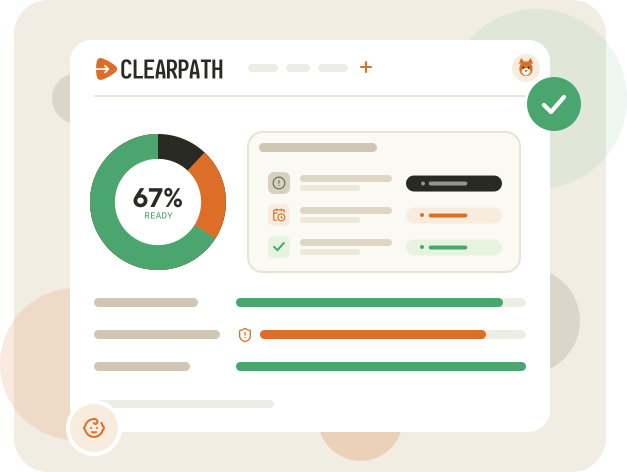
Childcare directors are personally, legally on the hook for a constantly shifting pile of credentials, immunization records, and classroom ratios. ClearPath pulls all of it into one always-current answer to the only question that matters on inspection day: right now, would we pass?
The Short Version
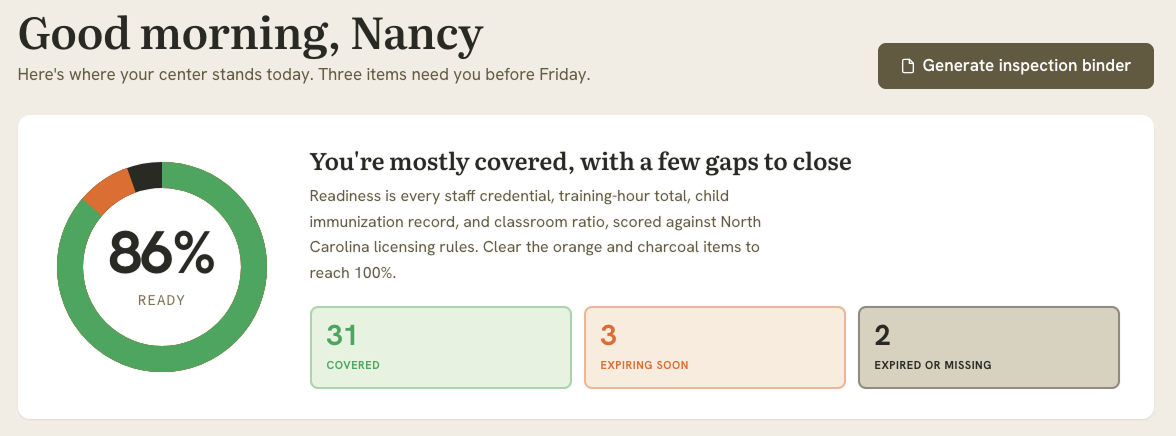
ClearPath is a single home for a licensed childcare center to stay inspection-ready. Every staff certification, training-hour tally, background check, child immunization record, and room ratio lives in one system that's continuously scored against the state's licensing rules. This allows a director to open the app and see exactly where the center stands.
Why It Exists
For a childcare director, compliance is the part of the job that carries real legal weight and is constantly in flux. A serious lapse can bring a citation, a fine, a mandated corrective-action plan, a knocked-down star rating, or ultimately, a suspension that shuts the doors.
The deadlines don't occur neatly. They're scattered across staggered, multi-year cycles, each one attached to a different person, a different room, or a different child. A director overseeing fifteen or twenty staff has to juggle dozens of independent expirations on top of every child's immunization schedule.
Most directors cope with this in the expected ways: a binder of certificates, a wall calendar, a spreadsheet, and a dose of panic the morning an unannounced licensing visit begins. What makes it dangerous is how easily lapses can go unnoticed.
The tools that exist don't close that gap. One end of the spectrum you might have a google drive with static documents, PDF templates, and an email-reminder subscription. At the other end are the all-in-one childcare platforms. Most of these handle compliance as a single tab buried inside a heavyweight system built mainly for billing, enrollment, and parent messaging.
ClearPath was purpose-built to anser one question a director carries around every day: right now, would we pass?
The idea
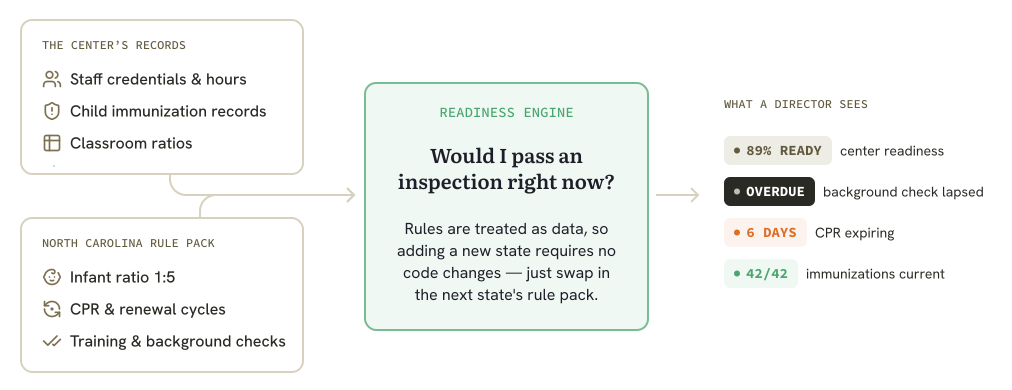
What separates a real compliance tool from a spreadsheet is whether anything beneath the surface is actually thinking, calculating, and responding to changes. Under ClearPath sits a readiness engine: a rule pack (scoped only to the state of North Carolina as a pilot) that continuously measures a center's real records against the state's actual requirements and produces every number, badge, and warning in the interface. None of it is decorative. When the dashboard reports "75% ready" with two items flagged, that figure is the engine working through live credentials, live immunization records, and live room ratios — not a status someone typed in.
Who's on the hook?
The persona I designed for is Nancy Winslow, the director who runs a fictional childcare center named Little Cardinals Learning Center. The center possesses roughly a dozen staff, about forty children, and an infant room. Nancy does a bit of everything, but compliance is the piece that follows her home, because it's the one with legal teeth and her signature on the license. She isn't resistant to software; she may already run billing or parent messaging through some other tool. A few dollars a month to stop bracing for the knock at the door is an easy yes.
Turning the rulebook into data
This product was a fun and challenging at the same time. Compliance rules are usually complex, they attach to different things, and they each run on their own cycle. Getting North Carolina right was the heart of the work.
The engine holds the rules as a swappable rule pack (content rather than logic) so adding another state later becomes a data exercise instead of a rewrite. North Carolina's pack has to represent obligations that live at four different altitudes:
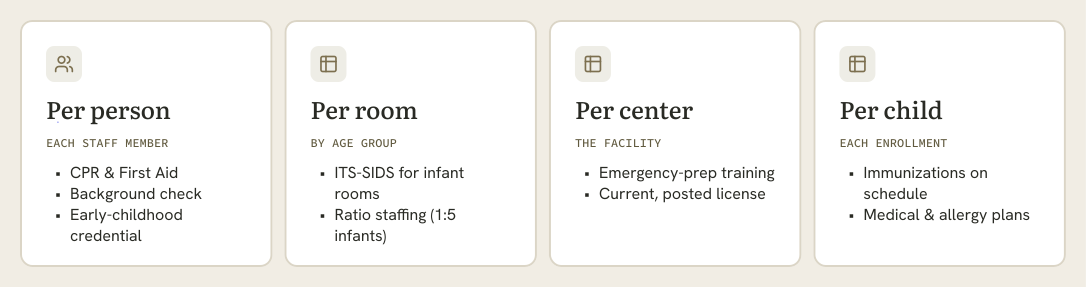
- On the individual. Everyone in direct care needs current CPR and First Aid, a cleared background check, and the right early-childhood credential — each renewing on its own schedule.
- On the room. Safe-sleep (ITS-SIDS) training is required for the director and anyone assigned to a room with infants under a year. This is a requirement that follows the assignment, not the person in isolation.
- On the center. At least one staff member has to hold Emergency Preparedness and Response training, and the license itself must be current and posted. No per-person screen would ever surface these.
- On the child. Every enrolled child needs an up-to-date immunization record on the state schedule, plus medical and allergy documentation.
Layered on top of the levels are the cycles that are difficult for a simple spreadsheet solution to account for sustainably.
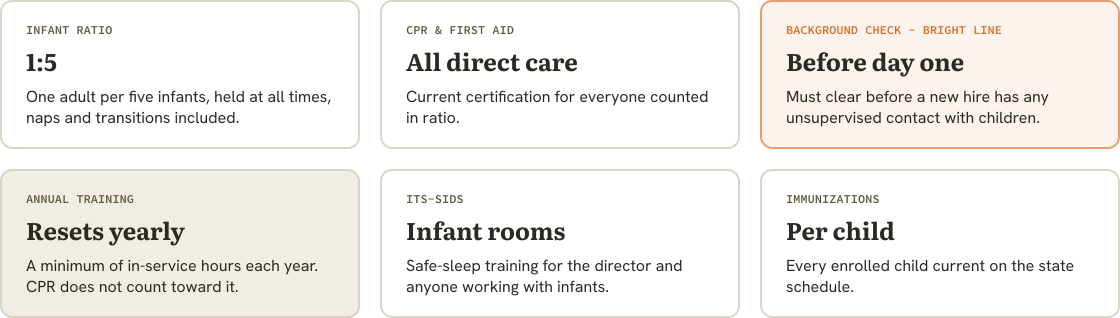
- CPR and First Aid don't count toward the yearly training requirement.
A director watching a single running total can hit the annual number and still fall short, because those weren't the qualifying hours. The engine keeps the two obligations separate, exactly as the state does. - In-service hours reset annually and scale down for part-time staff.
Required health-and-safety topics have to be covered over a rolling multi-year window rather than knocked out once. - A background check has to clear before a new hire is ever alone with children.
This is a hard rule, not a suggestion — and one of the highest-stakes rules in the whole product. - Required ratios persist.
Naps, meals, and the shuffle between activities and a mixed-age groups inherit the youngest child's ratio. In an infant room that means one adult for every five children, no exceptions.
All of these facets force the dashboard to resolve more than one question in the same glance: is each person individually covered, and is the center as a whole actually ready? Most competitor apps only handle the first. ClearPath reconciles staff, children, and ratios into one readiness figure, so "everybody's green, we're fine" doesn't backfire behind the scenes. Expired or missing credentials are among the state's most common citations; the product is built to make them the hardest thing to overlook.
Inside the Product
- Building the roster comes first.
Add staff, then log each credential indicating type, issue date, expiration, and an uploaded proof. For advanced users, a CSV import brings the whole roster in at once. - The dashboard is the daily habit.
One readiness donut chart answers "are we covered?" at a glance, backed by a ranked list of what needs attention, a by-area breakdown, and a recent-activity trail. Green is covered, orange is expiring, black is expired or missing. - The timeline keeps anything from sneaking up.
Everything with an expiration lands on a running schedule, soonest first, grouped into overdue, this week, this month, and the next ninety days. No surprises. - The ratio checker stays deliberately manual.
It confirms each room against its North Carolina ratio, and it stops there. No live, attendance-fed monitoring, which would pull the product toward the very platforms it defines itself against. Reference, not surveillance, was the right call for v1.
The payoff feature
The Inspection Binder
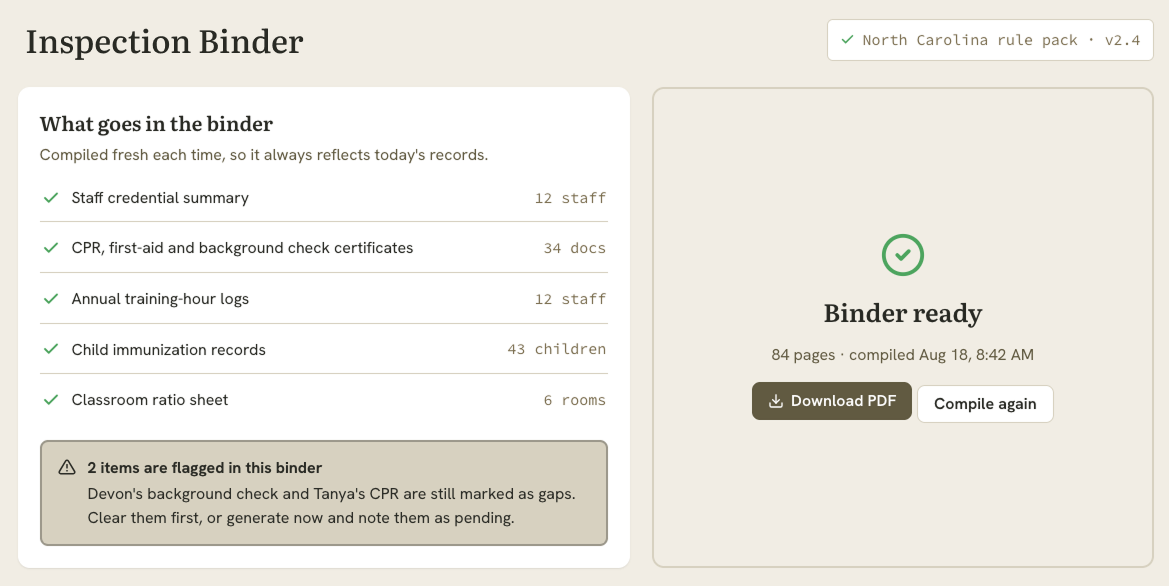
The most consequential design call was figuring out the one hero feature the director sorely needs, and organizing the whole product around producing it. For a director, that feature is an artifact they can provide directly to an inspector: a clean, ordered packet of every current staff file and child record, sequenced the way a surveyor expects to read it. ClearPath assembles it on demand. A single click pulls the whole thing together. It includes credential summaries, certificates, training logs, immunization records, and the ratio sheet. It marks anything still outstanding, and produces a print-ready PDF in seconds.
Craft & Brand
The prototype is built on chux-ui, my reusable design system. It keeps tokens, components, layout, and copy voice coherent from screen to screen. Everything about the UI - navigation, colors, page layout, etc. was intentional to make the information easily accessible to the director. The status colors were chosen for quick reads: a bright green for good, orange for expiring, and black for expired or missing, so the charts and badges function as a real signal system rather than ornamentation.
The writing is warm, capable, and calming on purpose. The product's entire reason to exist is to lower the anxiety, so the copy does too ("you're mostly covered, with a few gaps to close").
It all ships as one self-contained HTML file: live readiness logic, a populated roster with drill-in staff profiles, the expiration timeline, a three-step onboarding that loads the North Carolina rule pack, and the one-click binder. Plus, the app renders beautiful in a mobile browser so the director can monitor and compare as she walks the facility.
What It's Worth
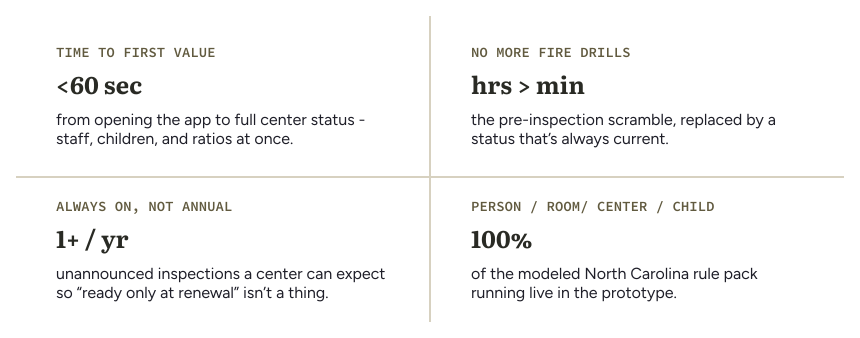
There are no live users yet, so what follows are modeled estimates scoped to public North Carolina figures rather than anything exact. Even so, they showcase the value nicely.
- Time & Effort
The time it takes periodically to answer the "are we actually ready?" reckoning. An afternoon of pulling certificates, checking dates, and hunting the one file that's gone missing. That's replaced with a status that's simply always current; a director can ascertain full center standing within about a minute of opening the app. Document autofill turns per-file credential entry from minutes of retyping into a glance and a tap, which matters most when a whole center's paperwork arrives together. - Risk Aversion
One citation can trigger a corrective-action plan, fines, and probationary status; a downgraded star rating can reduce subsidy reimbursement and enrollment appeal for a long time afterward; and in the worst case a suspended license halts revenue entirely while families go looking elsewhere. Measured against a subscription of a few dollars a week, it isn't a close call. ClearPath's fees pale in comparison to the costs of the failure it's designed to head off.
What It Proves
- I can turn complex regulations into working software.
North Carolina's childcare rules attach at four different levels — the person, the room, the center, and the child — and each runs on its own renewal clock. ClearPath encodes all of it as structured, swappable-by-state data, tricky edges included: CPR that doesn't count toward the annual training total, and a background check that has to clear before a new hire is ever alone with children. - I can make deliberate scope and value judgement calls.
I anchored on a single state and went deep instead of broad, held a firm v1 boundary (a manual ratio checker, not live monitoring), and left room in the schema for future users and states without building them yet. Differentiating ClearPath from its sibling project was a conscious choice too, so the two never blur together. - I can take an idea all the way to a working product.
The prototype isn't a collection of static screens. It actually runs, it's built on its own design system, it holds up responsively on a phone, and it's organized around one clearly chosen hero deliverable.
The Road Ahead
The app is scoped to North Carolina. I chose this because it's my home state. This will make it the most direct route to what this prototype needs next: time with a practicing director, to stress-test the rule pack against how an inspection actually feels from the inside and to open a path to real users and a proof of concept. The structure is deliberately set up so a second state is a new rule pack dropped in, not a rebuild.
While I'm proud of how this product looks, I'm more pleased with the rules themselves. Keeping that library accurate, state by state, is what would turn a sharp prototype into a real business. It's tedious enough that few will do it well, which is exactly why it's worth owning.